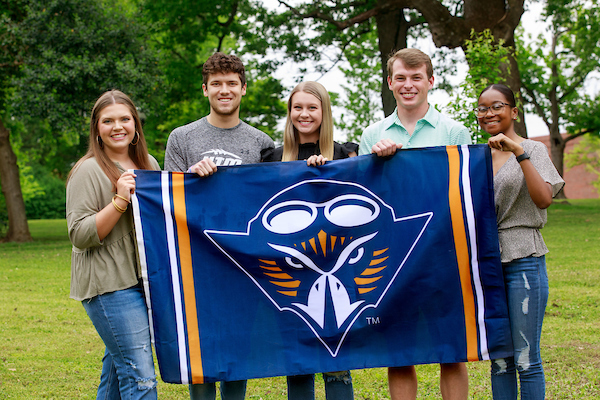
Do you love taking care of animals? Our veterinary health technology option can help you put your passion to work. Animal health care is a growing field that needs qualified professionals, and our veterinary health technology program is one of the most comprehensive in the country.
UT Martin is one of fewer than 30 institutions nationwide to offer an accredited four-year program in the area of veterinary health technology. Unlike two-year programs that have a limited focus, our veterinary technology concentration will prepare you to work with a wide variety of animal patients—everything from livestock to exotic pets.
Our comprehensive curriculum is just one of the reasons why our students have such a high rate of success. In fact, 96% of our veterinary technology students are hired in the field within 60 days of graduation—and many even have multiple job offers!
The American Veterinary Medical Association (AVMA) Committee on Veterinary Technician Education and Activities (CVTEA) accredits programs in veterinary technology that graduate veterinary technicians. UTM has been awarded Full Accreditation. All students who graduate after accreditation has been granted will be recognized as graduates of an accredited veterinary technology program.
American Veterinary Medical Association (AVMA)
Committee on Veterinary Technician Education and Activities (CVTEA)
Education and Research Division
1931 N. Meacham Rd., Suite 100
Schaumburg, IL 60173-4630
800/248-2862 ext. 6624
www.avma.org
Graduation from the veterinary technology option allows students to take the Veterinary Technology National Licensing Exam and following successful completion of both the option and exam, students are eligible for licensure in all states.
.jpg)
Students must meet the following criteria to enter the program:
Students must apply to UT Martin.
Once accepted to UTM, students can start taking general education and animal science requirements in veterinary technology.
Students can then apply specifically to the veterinary technology program when they meet the following requirements:
New classes will be admitted to the program each fall and spring semester. Deadline for fall applications will be May 1 of the year student plans to enter the program and applicants will be notified by July 1 of acceptance or denial. Deadline for spring applications will be December 1 and applicants will be notified by January 4 of acceptance or denial.
1730-3-.04 QUALIFICATIONS FOR LICENSURE. To be eligible for licensure as a veterinary medical technician, an applicant must meet all of the following qualifications.
(1) Veterinary Medical Technician by Examination
(a) Be a graduate of the Veterinary Technology program from a school whereby the veterinary technology curriculum was approved by the American Veterinary Medical Association.
(b) Pass the examination as provided in paragraph (1) of Rule 1730-3-.08.
1730-3-08 EXAMINATIONS.
Authority: T.C.A. 4-5-202, 4-5-204, 63-12-106, 63-12-114, 63-12-115, and 63-12-135. Administrative History: Original rule filed September 13, 1987; effective November 14, 1987. Repeal and new rule filed April 28, 1995; effective July 12, 1995. Amendment filed September 29, 2000; effective December 13, 2000. Amendment filed March 23, 2007; effective June 6, 2007.
The Veterinary Technician National Examination
National Association of Veterinary Technicians
Rabies Vaccine - What You Need to Know
The Centers for Disease Control and Prevention is the premier public health agency of the United States. Under the auspices of the CDC, the Advisory Committee on Immunization Practices periodically reviews the status of selected infectious diseases, including rabies, and issues national recommendations.
These recommendations reflect the status of rabies and antirabies biologics in the United States and provide guidance on level of risk. Therefore, the University of Tennessee at Martin Veterinary Technology Program accepts these national recommendations and considers rabies exposure a risk to our students and staff. Based on Center for Disease Control (CDC) recommendations, administrators of The University of Tennessee at Martin Veterinary Technology Program are requiring each student who enters the program to provide proof of pre‐exposure rabies vaccination or a protective rabies serum titer prior to entering the program. Students should contact their personal physician or local health department to receive the pre‐exposure vaccination series. The vaccination series costs on average about $350-$400 per injection, plus charges for an office visit and injection. Students should check with their health insurance provider to see if the rabies vaccine.

“I chose UT Martin because of the outstanding agriculture programs! UTM is an affordable school where everyone is so friendly and supportive. ”